
While moving out of our moldy house, I noticed that family members had a pungent-yet-sweet body odor that honestly kind of made me gag. I’ve always been sensitive to smells, and this one immediately set off my red flags.
A few months before we moved, a client had raved about how Remedy Body Wash had eliminated funky odors and skin irritation for his family, so I knew exactly what to add to my Amazon shopping cart that night!
It worked quickly and wonderfully for us, too. 🙂
As an Amazon Associate I earn from qualifying purchases.
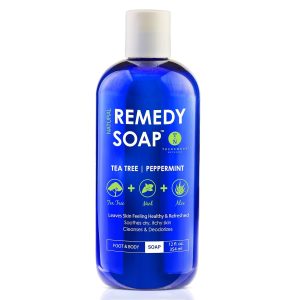
Truremedy Naturals Tea Tree Oil Body Wash
- Gel body wash contains tea tree, peppermint, and eucalyptus oils for a refreshing & invigorating scent
- Gentle plant-based ingredients wash the skin
- Coconut, olive, and jojoba oils create a hydrating formula that moisturizes skin instead of feeling drying
- Scent is perfect for men and women alike
- Note: this product does have a strong peppermint scent.
Important Details
- I’ve personally found that third party research suggests exercising caution when exposing children under age 10 to tea tree, ecualyptus, and peppermint oils. Please consult with a trusted and knowledgeable healthcare practitioner before using with children.
- A small amount goes a long way — this 12 oz. bottle lasts a long time!
- Check out other products in their product line for removing make-up and skin hydration + repair!
What the science says
Researchers have long studied several essential oils for their antibacterial and antifungal activity in laboratory settings.
Of course, activity in a petri dish does not automatically translate to clinical results in humans. However, research does provide insight into why these ingredients are commonly included in antimicrobial body washes.
Tea Tree Oil
Laboratory studies have demonstrated activity against:
- Staphylococcus aureus
- Methicillin-resistant Staphylococcus aureus (MRSA)
- Escherichia coli (E. coli)
- Streptococcus mutans
- Various other skin-associated bacteria
Researchers have also identified activity against:
- Candida albicans
- Candida glabrata
- Dermatophyte fungi associated with athlete’s foot and nail fungus
Tea tree oil appears to work in part by disrupting microbial cell membranes, making it difficult for certain organisms to survive and reproduce.
Peppermint Oil
Peppermint oil contains menthol and related plant compounds that have demonstrated antimicrobial activity in laboratory studies.
Researchers have reported activity against:
- Staphylococcus aureus
- Escherichia coli
- Klebsiella pneumoniae
- Pseudomonas aeruginosa
- Acinetobacter baumannii
Some studies have reported activity even against multidrug-resistant bacterial strains.
Peppermint oil has also demonstrated inhibitory effects against several fungal and yeast species, although the evidence base is smaller than what currently exists for tea tree oil.
Eucalyptus Oil
Most of eucalyptus oil’s antimicrobial activity is attributed to a compound called 1,8-cineole (eucalyptol).
Laboratory studies have demonstrated activity against:
- Staphylococcus aureus
- Escherichia coli
- Enterococcus faecalis
- Klebsiella pneumoniae
- Streptococcus pyogenes
Researchers have also documented antifungal activity against multiple fungal and yeast species.
While human clinical data remain limited, eucalyptus oil has demonstrated broad-spectrum antimicrobial activity in laboratory studies and continues to be an area of active research.
Why This Matters
People often focus on mold while overlooking the fact that the skin can also host complex communities of bacteria, yeast, fungi, and biofilms.
When that balance becomes disrupted, some individuals report changes in body odor, skin quality, or overall skin comfort.
We cannot determine what organisms may be present in any individual case, and unusual odors are not diagnostic of any specific condition.
However, the published research can help explain why many antimicrobial body washes contain ingredients such as tea tree, peppermint, and eucalyptus oils.
Learn More
Tea Tree Oil (Melaleuca alternifolia)
Carson CF, Hammer KA, Riley TV.
Melaleuca alternifolia (Tea Tree) Oil: A Review of Antimicrobial and Other Medicinal Properties.
Clinical Microbiology Reviews. 2006;19(1):50–62.
DOI: 10.1128/CMR.19.1.50-62.2006
PubMed: https://pubmed.ncbi.nlm.nih.gov/16418522/
Full text: https://pmc.ncbi.nlm.nih.gov/articles/PMC1360273/
Carson CF, Mee BJ, Riley TV.
Mechanism of Action of Melaleuca alternifolia (Tea Tree) Oil on Staphylococcus aureus Determined by Time-Kill, Lysis, Leakage, and Salt Tolerance Assays and Electron Microscopy.
Antimicrobial Agents and Chemotherapy. 2002;46(6):1914–1920.
DOI: 10.1128/AAC.46.6.1914-1920.2002
Full text: https://pmc.ncbi.nlm.nih.gov/articles/PMC127210/
Hammer KA, Carson CF, Riley TV.
In Vitro Activity of Melaleuca alternifolia (Tea Tree) Oil Against Candida Species.
Journal of Antimicrobial Chemotherapy. 1998;42(5):591–595.
DOI: 10.1093/jac/42.5.591
Referenced in later reviews.
Hammer KA, Carson CF, Riley TV.
Antifungal Activity of the Components of Melaleuca alternifolia (Tea Tree) Oil.
Journal of Applied Microbiology. 2003;95(4):853–860.
DOI: 10.1046/j.1365-2672.2003.02059.x
Referenced in later reviews.
Carson CF, Riley TV.
Antimicrobial Activity of the Major Components of the Essential Oil of Melaleuca alternifolia.
Journal of Applied Bacteriology. 1995;78(3):264–269.
PubMed: https://pubmed.ncbi.nlm.nih.gov/7730203/
Peppermint Oil (Mentha × piperita)
Muntean D, Licker M, Alexa E, et al.
Evaluation of Essential Oil Obtained from Mentha × piperita L. Against Multidrug-Resistant Strains.
Infection and Drug Resistance. 2019;12:2905–2914.
DOI: 10.2147/IDR.S218141
Full text: https://pmc.ncbi.nlm.nih.gov/articles/PMC6751511/
Li J, Dong Y, Chen Z, et al.
Peppermint Oil Decreases the Production of Virulence-Associated Exoproteins by Staphylococcus aureus.
Molecules. 2011;16(2):1642–1654.
Full text: https://pmc.ncbi.nlm.nih.gov/articles/PMC6259925/
Kang J, Liu L, Wu X, et al.
Antibacterial and Anti-Biofilm Activities of Peppermint Essential Oil Against Staphylococcus aureus.
LWT – Food Science and Technology. 2019;101:639–645.
DOI: 10.1016/j.lwt.2018.11.093
Sivropoulou A, Kokkini S, Lanaras T, Arsenakis M.
Antimicrobial Activity of Mint Essential Oils.
Journal of Agricultural and Food Chemistry. 1995;43(9):2384–2388.
DOI: 10.1021/jf00057a013
Eucalyptus Oil
Bachir RG, Benali M.
Antibacterial Activity of the Essential Oils from the Leaves of Eucalyptus globulus Against Escherichia coli and Staphylococcus aureus.
Asian Pacific Journal of Tropical Biomedicine. 2012;2(9):739–742.
PMCID: PMC3609377
Full text: https://pmc.ncbi.nlm.nih.gov/articles/PMC3609377/
Dhakad AK, Pandey VV, Beg S, Rawat JM, Singh A.
Biological, Medicinal and Toxicological Significance of Eucalyptus Leaf Essential Oil: A Review.
Journal of the Science of Food and Agriculture. 2018;98(3):833–848.
DOI: 10.1002/jsfa.8600
Elaissi A, Salah KH, Mabrouk S, et al.
Antibacterial Activity and Chemical Composition of 20 Eucalyptus Species’ Essential Oils.
Food Chemistry. 2011;129(4):1427–1434.
DOI: 10.1016/j.foodchem.2011.05.100
Nazzaro F, Fratianni F, Coppola R, De Feo V.
Essential Oils and Antifungal Activity.
Pharmaceuticals. 2017;10(4):86.
PMCID: PMC5748643
General Essential Oil Antimicrobial Reviews
These are useful umbrella citations for the overall antimicrobial discussion:
Chouhan S, Sharma K, Guleria S.
Antimicrobial Activity of Some Essential Oils—Present Status and Future Perspectives.
Medicines. 2017;4(3):58.
PMCID: PMC5622393
Full text: https://pmc.ncbi.nlm.nih.gov/articles/PMC5622393/
Nascimento T, Fernandes CP, Santos RL, et al.
Tea Tree Oil: Properties and the Therapeutic Approach to Acne—A Review.
Antibiotics. 2023;12(6):1020.
PMCID: PMC10295805
Full text: https://pmc.ncbi.nlm.nih.gov/articles/PMC10295805/